
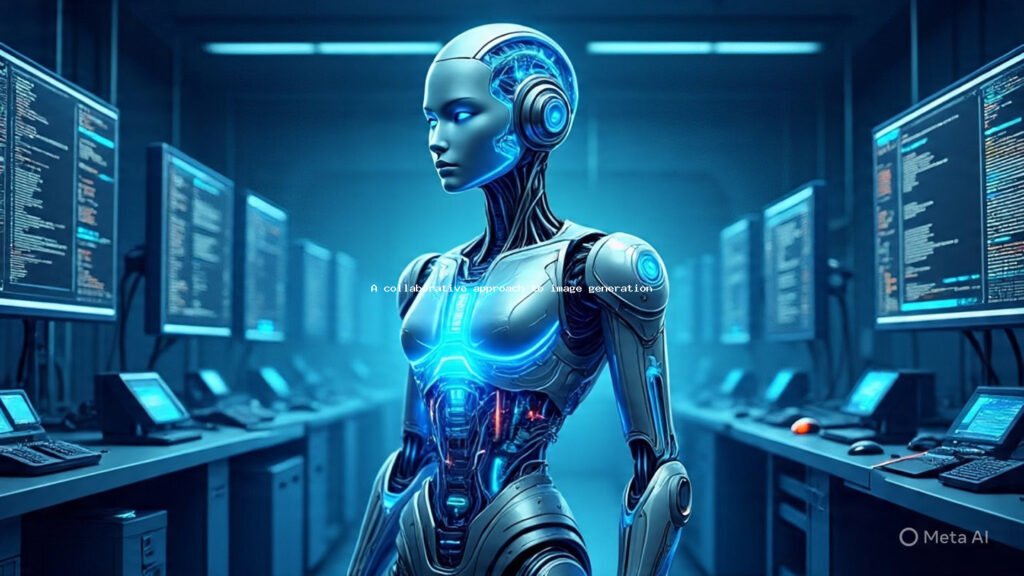
A collaborative approach to image generation
A collaborative approach to image generation
The landscape of digital creation has been irrevocably transformed by the advent of generative Artificial Intelligence, particularly in the realm of image generation. What began as a nascent curiosity, with tools like DALL-E, Midjourney, and Stable Diffusion capturing public imagination, has rapidly evolved into a sophisticated ecosystem capable of producing stunning, imaginative, and often photo-realistic visuals from mere text prompts. These powerful models have democratized art, allowing individuals without traditional artistic skills to conjure complex scenes, unique characters, and abstract concepts with unprecedented ease. However, as the capabilities of these AI systems deepen, so too does the complexity of the creative process. The solitary act of an individual meticulously crafting prompts to guide an AI towards a desired outcome, while undeniably powerful, often encounters limitations. The sheer breadth of knowledge required – from understanding nuanced prompt engineering techniques to grasping the artistic principles of composition, lighting, and style – can be overwhelming. This is where the concept of a “collaborative approach to image generation” emerges not just as an interesting idea, but as an essential evolutionary step for the field.
Collaboration in AI image generation signifies a fundamental shift from isolated creativity to a shared, iterative, and synergistic process. It acknowledges that the most groundbreaking and intricate visual outputs often benefit from a multitude of perspectives, diverse skill sets, and collective intelligence. Imagine an artist providing stylistic direction, a prompt engineer refining the textual inputs, a domain expert ensuring accuracy, and a project manager orchestrating the workflow – all contributing to a single, evolving visual project. Recent developments underscore this shift, with platforms and communities actively fostering environments where creators can build upon each other’s work, share insights, fine-tune models collectively, and even co-create in real-time. This collaborative paradigm promises to unlock new levels of creativity, efficiency, and accessibility, pushing the boundaries of what’s possible when human ingenuity and artificial intelligence converge in a shared creative space. It’s about moving beyond simply instructing an AI to a dynamic interaction where multiple human minds, often distributed across geographies and disciplines, guide and refine the AI’s output together, transforming complex visions into tangible realities with a speed and richness that solitary efforts could rarely achieve.
The Evolution of Generative AI: From Solitary Prompts to Shared Canvases
The journey of generative AI in image creation began, for most users, as a deeply personal exploration. Early adopters would spend hours, sometimes days, meticulously crafting prompts, tweaking parameters, and experimenting with various models to achieve a desired output. This solitary pursuit, while fascinating and empowering, quickly revealed its inherent limitations. The “prompt fatigue” phenomenon became real – hitting a creative wall when individual ideas or prompt variations ran dry. The skill ceiling for mastering prompt engineering, understanding model nuances, and achieving artistic consistency was high, often requiring a blend of technical acumen and artistic sensibility. Furthermore, complex projects demanding diverse visual elements or intricate narratives often overwhelmed a single creator’s capacity, leading to fragmented results or an inability to fully realize ambitious visions.
The transition to a collaborative approach directly addresses these challenges. By moving from a single user directing an AI to multiple individuals contributing to a shared creative endeavor, the process becomes exponentially more robust. Collaboration allows for the distribution of effort, where one person might specialize in character design prompts, another in environmental details, and yet another in stylistic rendering. This division of labor not only accelerates the creation process but also significantly elevates the quality and complexity of the output. Shared knowledge becomes a powerful accelerator; community forums, Discord servers, and specialized platforms now thrive on users openly sharing successful prompts, experimental techniques, and custom-trained models (LoRAs). This collective intelligence acts as a vast, ever-growing library of creative solutions and inspirations, far surpassing what any individual could amass alone. The very act of iteration benefits immensely from multiple eyes and minds, offering diverse feedback and fresh perspectives that can guide the AI towards increasingly refined and innovative results.
The Power of Collective Intelligence
Collective intelligence in AI image generation manifests in various forms. It’s evident in the open-source community’s rapid development and sharing of new Stable Diffusion models and checkpoints, where thousands of developers and artists contribute to a global pool of resources. It’s also present in smaller, focused teams working on a specific project, where designers, marketers, and copywriters might pool their expertise to generate a series of images for an advertising campaign. Each contributor brings a unique perspective – a marketer might focus on audience appeal, a designer on aesthetic coherence, and a copywriter on narrative integration. This synergy ensures that the final output is not only visually compelling but also strategically aligned with project goals. The democratization of high-quality image generation through collaborative platforms means that smaller studios, independent creators, and even hobbyists can access and leverage a breadth of expertise previously reserved for large, well-funded organizations. This is a profound shift, redefining who can participate in and benefit from the AI-powered creative revolution.
Overcoming Creative Blocks
One of the most insidious obstacles in any creative process is the “creative block.” When working alone with AI, this often translates to prompt fatigue or an inability to envision new directions. Collaboration offers a potent antidote. A fresh pair of eyes can often see possibilities that an individual, deeply immersed in their own work, might overlook. Brainstorming sessions, even virtual ones, where participants throw out wild ideas or subtle refinements, can quickly break through stagnant periods. Furthermore, the accountability inherent in a collaborative project can provide the necessary impetus to keep momentum going. Knowing that others are relying on your contribution, or that you are contributing to a larger shared vision, can be a powerful motivator. This communal support system not only fosters creativity but also builds stronger bonds within creative communities, transforming potentially isolating work into an engaging, shared adventure.
Key Modalities and Platforms for Collaborative Image Generation
The collaborative approach to AI image generation isn’t a monolithic concept; it encompasses several distinct modalities and relies on a growing ecosystem of platforms designed to facilitate shared creativity. Understanding these different methods is crucial for leveraging the full potential of collective intelligence in this space. At its core, collaboration often begins with Prompt Sharing & Iteration. This is the most basic yet powerful form, where users share their successful prompts and generated images, allowing others to learn, modify, and build upon them. Platforms like Midjourney’s public feeds, Stable Diffusion communities on Reddit, and dedicated prompt repositories serve as vast libraries of inspiration, enabling creators to iteratively refine concepts developed by others, injecting their own unique twists and improvements.
Beyond simple prompt sharing, more advanced forms of collaboration involve shared technical development. Model Fine-tuning & LoRA Creation exemplifies this. Communities frequently collaborate on training specialized models (checkpoints) or Low-Rank Adaptation (LoRA) modules that excel in specific styles, subjects, or aesthetic qualities. Developers and artists contribute data, computational resources, and expertise to create these shared assets, which then become available to the wider community. Platforms like Civitai have become central hubs for sharing and discovering these community-contributed models, allowing users to combine different LoRAs to achieve highly specific artistic results, effectively building a collective toolkit of creative capabilities.
Another crucial modality involves direct visual co-creation, particularly through techniques like Inpainting/Outpainting & Image Editing. Here, a base image generated by one individual can be passed to others for further refinement. One collaborator might use inpainting to replace specific elements within the image, another might expand the canvas using outpainting to add context, and a third might apply traditional digital art techniques to blend and polish the AI-generated elements. This mirrors traditional artistic collaboration where different specialists contribute to various stages of a painting or digital artwork. Furthermore, the integration of ControlNet & Multi-modal Input enhances collaborative possibilities by allowing different contributors to provide diverse input types. An artist might provide a sketch via ControlNet for pose or composition, a photographer might provide a reference image for lighting, and a prompt engineer might refine the textual description, all converging to guide the AI’s output with granular control. This multi-modal input streamlines the process of translating complex, multi-faceted creative briefs into cohesive visual outcomes.
Tools and Workflows
The tools facilitating this collaboration range from general-purpose communication platforms like Discord, which host countless AI art communities sharing prompts and techniques, to specialized platforms. Hugging Face Spaces, for instance, allows developers to host and share interactive demos of their AI models, enabling a form of collaborative experimentation and feedback. Emerging platforms are even attempting to build Figma-like interfaces for AI art, where multiple users can simultaneously manipulate prompts, adjust parameters, and view real-time updates to the generated images on a shared canvas. These tools are crucial for establishing efficient workflows, ensuring version control, and maintaining clear communication among collaborators, moving beyond simple sharing to active, concurrent co-creation.
Community-Driven Innovation
The very fabric of AI image generation is woven with community-driven innovation. Open-source projects, particularly those built around Stable Diffusion, thrive on the contributions of thousands of individuals worldwide. This decentralized development model ensures rapid iteration, diverse feature sets, and a quick response to emerging needs or challenges. From developing new algorithms for better image quality to creating user-friendly interfaces, the community is a powerful engine of progress. This collective effort not only pushes the technical boundaries of what AI can achieve but also fosters a culture of sharing, learning, and mutual support, making the entire ecosystem more robust and accessible. The synergy between individual ingenuity and collective action is what truly defines the collaborative spirit of AI image generation, promising an even more exciting future as these communities continue to grow and evolve. https://7minutetimer.com/web-stories/learn-how-to-prune-plants-must-know/
Impact on Industries: Reshaping Creative Workflows
The collaborative approach to image generation is not merely a novelty for individual artists; it represents a profound paradigm shift with far-reaching implications across numerous industries. By enabling teams to harness the power of AI in a coordinated manner, businesses can unlock unprecedented levels of efficiency, creativity, and responsiveness, fundamentally reshaping traditional creative workflows. The sheer speed at which diverse visual concepts can be generated, refined, and iterated upon transforms product cycles and marketing campaigns, making them more dynamic and adaptable than ever before.
In the realm of Advertising & Marketing, collaborative AI image generation is a game-changer. Teams can rapidly brainstorm and visualize a multitude of campaign concepts, ad variations, and social media visuals in a fraction of the time it would take with traditional methods. A marketing strategist can outline a concept, a copywriter can contribute specific keywords for emotional resonance, and a designer can refine stylistic elements, all converging to produce highly targeted and visually compelling advertisements. This iterative feedback loop accelerates A/B testing and allows for quick adaptation to market trends, ensuring campaigns remain fresh and engaging. For Game Development, the impact is equally transformative. Concept artists, environment designers, and asset creators can collaboratively generate unique characters, intricate world elements, and stylistic textures at an astonishing pace. This not only speeds up the pre-production phase but also allows for greater experimentation with visual styles and thematic elements, reducing the time and cost associated with creating high-fidelity assets. Imagine a team collaboratively populating an entire game world with unique flora, fauna, and architectural details within days, rather than months.
The Film & Animation industry stands to benefit immensely from collaborative AI. Storyboarding, visual development, and even early-stage special effects can be accelerated. Directors, cinematographers, and production designers can co-create visual sequences, explore different moods and lighting setups, and rapidly prototype entire scenes before committing to costly production. This significantly de-risks the creative process and allows for more ambitious visual storytelling. Similarly, in Fashion & Product Design, collaborative AI enables rapid prototyping and trend exploration. Designers can generate countless variations of garments, accessories, or product designs, experimenting with colors, textures, and forms almost instantaneously. This accelerates the design cycle, allows for immediate visualization of consumer trends, and facilitates a more agile response to market demands. Even in fields like Architecture & Interior Design, teams can collaboratively visualize spaces, experiment with material palettes, and generate photorealistic renderings of design concepts, enabling clients and stakeholders to experience proposed designs in an immersive and detailed manner long before construction begins. https://newskiosk.pro/tool-category/upcoming-tool/
Accelerating Creative Pipelines
The primary benefit across all these industries is the acceleration of creative pipelines. What once took weeks or months of manual effort, multiple revisions, and extensive human resources can now be compressed into days or even hours. This speed allows companies to be more responsive, innovative, and competitive. It frees up human creatives from repetitive, laborious tasks, allowing them to focus on higher-level strategic thinking, conceptual development, and the nuanced refinement that only human judgment can provide. The AI becomes a powerful assistant, not a replacement, amplifying human creativity rather than supplanting it.
Democratizing Design
Beyond speed, collaborative AI image generation also democratizes design. Small businesses, independent creators, and startups can access high-quality visual assets and creative capabilities that were previously exclusive to large corporations with extensive budgets. This levels the playing field, fostering greater innovation and competition across industries. It empowers diverse voices to contribute to the visual landscape, breaking down barriers to entry and enriching the overall creative output. This democratization extends to cross-functional teams within larger organizations, allowing non-designers to actively participate in the visual conceptualization process, leading to more integrated and holistic creative outcomes.
Challenges and Ethical Considerations in Collaborative AI Art
While the collaborative approach to AI image generation promises unprecedented creative possibilities, it also introduces a complex array of challenges and ethical considerations that demand careful attention. Navigating these issues is crucial for ensuring the responsible and sustainable development of this burgeoning field. One of the foremost concerns is Attribution & Ownership. When multiple individuals contribute prompts, refine settings, or even fine-tune models to generate a single image, determining who “owns” the final piece becomes incredibly complex. How are contributions weighed? Is the person who wrote the initial prompt the primary owner, or the one who provided the final critical refinement? Traditional copyright law struggles with these distributed authorship models, and blockchain-based solutions or explicit collaborative agreements may be necessary to track and acknowledge contributions transparently. The issue is further complicated by the fact that the underlying AI models are often trained on vast datasets of existing human-created art, raising questions about the originality and derivative nature of the AI’s output itself.
Another significant concern is the potential for Bias & Misinformation. AI models are trained on existing data, and if that data contains biases (e.g., underrepresentation of certain demographics, perpetuation of stereotypes), the AI will inevitably amplify these biases in its generated images. In a collaborative setting, if multiple users are unaware or uncritical of these inherent biases, they can inadvertently reinforce and propagate harmful visual stereotypes or even generate misleading or false imagery. This necessitates robust content moderation, ethical guidelines for prompt engineering, and a critical awareness among collaborators about the potential societal impact of their creations. The ease with which highly realistic, yet entirely fabricated, images can be generated also raises serious questions about the spread of misinformation and deepfakes, demanding greater transparency about the AI-generated nature of images and the responsible use of these powerful tools. https://newskiosk.pro/tool-category/how-to-guides/
Quality Control & Consistency pose practical challenges in collaborative projects. When multiple hands are guiding an AI, maintaining a coherent artistic vision and consistent quality across a series of images can be difficult. Different prompt engineers might have varying styles or preferences, leading to a fragmented aesthetic. Establishing clear guidelines, utilizing shared style guides, and implementing a strong lead creative director role become essential for ensuring a unified output. Moreover, the broader issue of Intellectual Property remains a contentious area. Who owns the rights to images generated by AI? Does it belong to the user, the model developer, or is it uncopyrightable? What about the intellectual property of the artists whose work was used to train the AI? These legal ambiguities create significant uncertainty for commercial applications and require ongoing dialogue between legal experts, artists, and AI developers. Finally, the Digital Divide is an ethical consideration, as access to powerful AI models, high-end computational resources, and collaborative platforms is not universally equitable. This could exacerbate existing inequalities, limiting participation to those with the necessary technological access and digital literacy.
Navigating Ownership and Attribution
To navigate the complexities of ownership and attribution, collaborative projects can adopt several strategies. Clear contractual agreements between collaborators detailing contribution percentages and ownership stakes are essential. Implementing digital watermarking or metadata tagging that records all contributors and their roles can provide a robust audit trail. Furthermore, exploring distributed ledger technologies (like blockchain) for immutable attribution records offers a promising path forward. The goal is to ensure that every individual who contributes to a piece of AI-generated art receives appropriate recognition and, where applicable, compensation.
Mitigating Bias and Misuse
Mitigating bias and preventing misuse requires a multi-pronged approach. Developers must prioritize creating more diverse and representative training datasets and implementing bias detection and mitigation techniques within their models. For users, ethical prompt engineering – consciously avoiding discriminatory language or problematic stereotypes – is paramount. Platforms need robust reporting mechanisms and content moderation policies to address harmful outputs. Educating collaborators on ethical AI principles and the potential for misuse is also a critical step. Ultimately, fostering a culture of responsibility and critical thinking within collaborative AI communities is key to harnessing its power for good while minimizing its potential harms. https://7minutetimer.com/
The Future Landscape: Advanced Collaboration and AI Co-Creation
The current state of collaborative AI image generation, while impressive, is merely a precursor to a far more integrated and dynamic future. We are on the cusp of an era where collaboration extends beyond human-to-human interaction through AI tools, evolving into genuine human-AI co-creation. Imagine a future where the AI isn’t just a passive renderer of prompts but an active participant, a creative partner capable of suggesting directions, offering stylistic alternatives, and even initiating novel concepts based on an understanding of the project’s goals and the team’s preferences. This next frontier promises to redefine creativity itself.
One of the most anticipated advancements is the development of real-time collaborative interfaces. Think of Google Docs or Figma, but for image generation. Multiple users, regardless of their physical location, could simultaneously interact with a shared AI canvas, adjusting prompts, refining parameters, and seeing the AI’s output evolve in real-time. Such interfaces would incorporate sophisticated version control, allowing teams to track every iteration, revert to previous states, and attribute contributions seamlessly. This would enable highly fluid and responsive creative sessions, akin to a jam session where ideas bounce off each other, instantly materializing into visual forms. Furthermore, the integration with VR/AR for immersive creative spaces will transform how we interact with these tools. Imagine stepping into a virtual studio where you can sculpt 3D environments with AI-generated textures, populate scenes with AI-designed characters, and collaboratively manipulate visual elements in a truly immersive, spatial environment. This could revolutionize industries like architecture, game design, and film pre-visualization.
The role of AI itself is set to evolve dramatically. We will see the emergence of specialized AI agents, each designed for a specific task within a collaborative project. One agent might specialize in generating realistic human figures, another in fantastical landscapes, and a third in abstract textures, all working in concert under human direction. More profoundly, AI will transition from being a mere tool to an active collaborative partner. This means AI systems capable of understanding high-level creative briefs, asking clarifying questions, identifying gaps in a visual narrative, and even proposing entirely new creative directions. An “AI creative director” could analyze a brand’s guidelines, a project’s mood board, and the team’s past successes to offer intelligent suggestions, refine prompts, and ensure consistency across a large-scale campaign. This level of AI autonomy and creativity will challenge our current understanding of authorship and intellectual property even further, necessitating new legal frameworks and ethical guidelines.
Real-time Co-creation Environments
The development of real-time co-creation environments is paramount for the next wave of collaborative AI. These platforms will move beyond simple text prompts to incorporate intuitive visual controls, gesture interfaces, and even voice commands. Imagine a designer sketching a rough outline, while an AI instantly fills in details based on a collective prompt, and another team member simultaneously adjusts the lighting or color palette with a simple slider. Such dynamic interactions will blur the lines between human input and AI output, making the creative process feel more like a seamless extension of thought. These environments will also integrate sophisticated feedback loops, allowing the AI to learn from human preferences and adapt its suggestions over time, making it an increasingly valuable and personalized creative partner. https://newskiosk.pro/tool-category/how-to-guides/
AI as a Collaborative Partner
The vision of AI as a true collaborative partner is perhaps the most exciting and challenging aspect of the future. This involves AIs that are not just reactive but proactive, offering creative insights and taking initiative. For example, an AI could analyze a generated image, identify potential improvements in composition or color harmony, and then suggest modified prompts or direct manipulations. It could even generate entirely new variations that surprise and inspire human collaborators, pushing the boundaries of their initial vision. This shift requires AIs with a deeper understanding of aesthetics, narrative, and human intention, moving towards truly intelligent co-creation where the distinction between human and machine contribution becomes beautifully interwoven. The future of image generation is not just about tools, but about forging new kinds of creative partnerships. https://7minutetimer.com/web-stories/learn-how-to-prune-plants-must-know/
Comparison of Collaborative AI Image Generation Approaches
To better understand the diverse landscape of collaborative AI image generation, let’s compare some prominent tools, models, and conceptual approaches. Each offers unique strengths and is suited for different types of collaborative workflows.
| Approach/Tool | Primary Collaboration Method | Strengths | Weaknesses/Challenges | Ideal Use Case |
|---|---|---|---|---|
| Midjourney (Community Edition) | Shared prompt feeds, remixing, iterative prompting in Discord channels. | High artistic quality, intuitive prompt interpretation, strong community feedback, easy remixing. | Limited direct model control, reliance on Discord interface, less transparency in model mechanics, attribution challenges. | Rapid concept art generation, style exploration, community art challenges, creative brainstorming. |
| Stable Diffusion (Open Source) | Model sharing (checkpoints, LoRAs), prompt sharing, ControlNet collaboration, community fine-tuning. | Maximum flexibility & control, vast ecosystem of custom models, strong community development, local execution. | Steeper learning curve, requires technical setup, consistency across collaborators can be challenging without strict guidelines. | Developing specialized models, complex visual projects, integrating with existing pipelines, research & development. |
| Hugging Face Spaces/Gradio Demos | Sharing interactive web demos of custom models/workflows, crowd-sourced feedback. | Easy sharing & access to experimental models, direct user interaction for testing, broad community engagement. | Less direct real-time co-creation, primarily for demonstration/testing, not full project management. | Sharing research prototypes, community testing of new features, showcasing niche AI models, educational purposes. |
| Civitai (Model/LoRA Repository) | Sharing & downloading community-trained models (checkpoints, LoRAs, Textual Inversions), prompt sharing. | Centralized hub for custom AI art assets, easy discovery, robust categorization, vibrant community for specific styles. | Focus on assets rather than real-time co-creation, potential for model misuse if not vetted, quality variation. | Finding specialized styles, enhancing existing models, sharing custom training data, building a collective asset library. |
| Conceptual Real-time Co-creation Platform (e.g., “AI Figma”) | Synchronous editing of prompts/parameters, shared canvas, multi-user control, version history. | True real-time collaboration, immediate visual feedback, integrated project management, streamlined workflow. | Technically complex to build, requires robust infrastructure, potential for creative conflict without clear roles. | Professional design studios, large-scale media production, educational workshops, intricate collaborative art projects. |
This table illustrates that collaboration in AI image generation exists on a spectrum, from asynchronous sharing of resources to highly integrated, synchronous co-creation environments. The choice of approach depends heavily on the project’s scale, the team’s technical proficiency, and the desired level of creative control and interaction.
Expert Tips for Successful Collaborative AI Image Generation
Engaging in collaborative AI image generation can be incredibly rewarding, but it requires more than just knowing how to prompt an AI. Here are 8-10 expert tips to ensure your collaborative projects run smoothly and yield exceptional results:
- Define Roles and Responsibilities Clearly: Before starting, establish who is responsible for prompt engineering, style direction, image refinement, quality control, and final selection. Clear roles prevent creative conflicts and ensure a cohesive vision.
- Establish a Central Communication Hub: Use a dedicated platform (Discord, Slack, project management tool) for all discussions, feedback, and sharing. This keeps everyone on the same page and centralizes information.
- Utilize Version Control: Treat your AI art project like a software development project. Implement a system for saving different iterations, noting changes, and tracking who made them. This could be as simple as naming conventions or as complex as integrated version control in a dedicated platform.
- Create a Shared Style Guide or Mood Board: Before generating, agree on the desired aesthetic, mood, color palette, and overall style. A visual guide helps maintain consistency across different contributors and AI generations.
- Document Prompts and Parameters Meticulously: For every successful generation, save the exact prompt, seed, model, sampler, and any other relevant parameters. This is crucial for replication, iteration, and understanding what works.
- Embrace Iteration and Feedback: Collaborative AI art is an iterative process. Encourage open, constructive feedback and be prepared to make numerous adjustments. The best results often emerge from a series of refinements.
- Leverage Community Resources and Custom Models: Don’t reinvent the wheel. Explore community-shared LoRAs, checkpoints, and prompt examples on platforms like Civitai or Hugging Face. These can provide excellent starting points or specific stylistic enhancements.
- Experiment Beyond Text Prompts: Incorporate multi-modal inputs. Use ControlNet with sketches or reference images, leverage image-to-image prompting, or combine multiple techniques to guide the AI more precisely.
- Set Realistic Expectations: AI is powerful, but it’s not magic. Complex visions still require significant human guidance and refinement. Understand that some ideas may require more iterations than others.
- Attribute Contributions Fairly: In the final output, ensure that all significant contributors are acknowledged appropriately. This fosters a positive collaborative environment and respects intellectual effort.
Frequently Asked Questions (FAQ)
What is collaborative image generation in AI?
Collaborative image generation in AI refers to the process where multiple individuals work together, leveraging artificial intelligence tools, to create visual content. Instead of a single user inputting prompts, a team might contribute different aspects like prompt engineering, stylistic direction, image refinement, or model fine-tuning to achieve a shared creative goal. It shifts AI art from a solitary act to a shared endeavor.
Who can benefit from a collaborative approach to AI image generation?
A wide range of individuals and organizations can benefit, including creative agencies, marketing teams, game developers, film studios, product designers, architects, independent artists, and even hobbyist communities. It’s particularly useful for complex projects requiring diverse skill sets, rapid iteration, or a consistent aesthetic across multiple visual assets.
What are the biggest challenges in collaborative AI art?
Key challenges include determining ownership and attribution when multiple parties contribute, maintaining consistent quality and style across different contributors, mitigating bias inherent in AI models, and navigating the evolving legal landscape of intellectual property for AI-generated content. Effective communication and clear guidelines are crucial for overcoming these.
How do I ensure fair attribution for collaborators?
To ensure fair attribution, establish clear agreements at the outset defining roles and contributions. Utilize project management tools that track changes and contributors. Consider implementing digital watermarking or metadata within the image files to record all participants. For larger projects, exploring blockchain-based solutions for immutable attribution records can also be an option.
Is special software needed for collaborative AI image generation?
While basic collaboration can happen through shared prompts on platforms like Discord or public galleries, more advanced collaboration benefits from specialized tools. These can include dedicated project management software, platforms that allow shared access to AI interfaces (like a conceptual “AI Figma”), or community repositories for sharing custom models (e.g., Civitai, Hugging Face Spaces). Many open-source AI tools also allow for local collaboration through shared files and settings.
How does collaborative AI image generation differ from traditional digital art collaboration?
The core difference lies in the integration of AI as a creative partner. In traditional digital art, collaborators directly manipulate pixels and layers. In AI collaboration, human input primarily guides an AI model through prompts, parameters, and reference images, with the AI doing the heavy lifting of image synthesis. This allows for significantly faster iteration, exploration of vast creative spaces, and the ability for non-artists to contribute visually, fundamentally altering the nature of the creative workflow.
The collaborative approach to image generation is not just a trend