
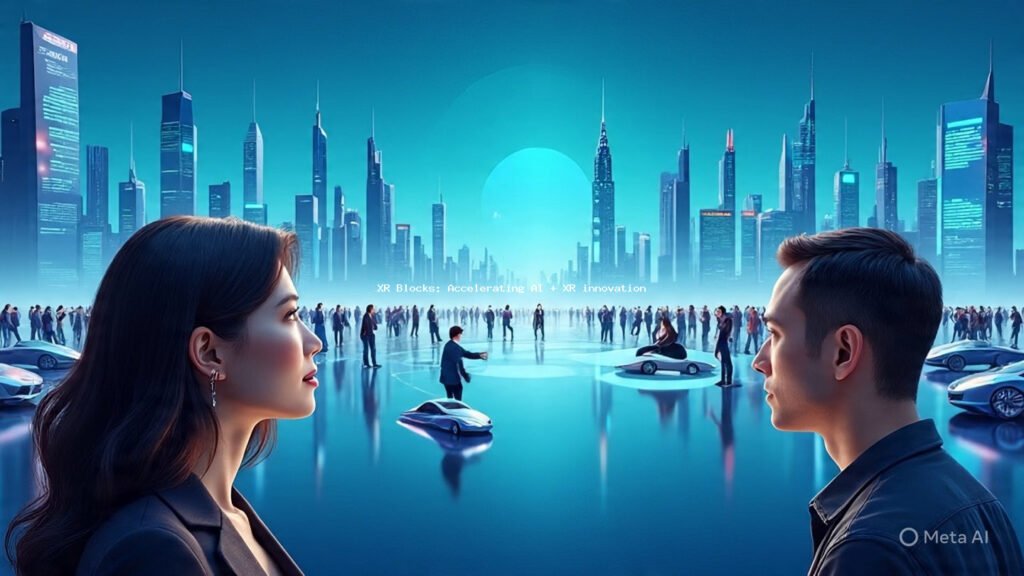
XR Blocks: Accelerating AI + XR innovation
XR Blocks: Accelerating AI + XR innovation
The convergence of Artificial Intelligence (AI) and Extended Reality (XR) stands as one of the most exciting and transformative frontiers in technology today. For years, XR – encompassing Virtual Reality (VR), Augmented Reality (AR), and Mixed Reality (MR) – has promised immersive experiences, but often grappled with development complexities, static content, and limited intelligence. Simultaneously, AI has advanced at an unprecedented pace, delivering capabilities in perception, understanding, and generation that were once confined to science fiction. The fusion of these two powerhouses is giving rise to a new paradigm: intelligent spatial computing, where digital worlds are not just seen but understood, interacted with naturally, and dynamically generated in real-time. This is where the concept of “XR Blocks” emerges as a critical enabler. XR Blocks represent a modular, AI-infused approach to building XR applications, abstracting away much of the underlying complexity and allowing developers to focus on crafting truly intelligent, adaptive, and personalized experiences. We are moving beyond rigid, pre-defined digital environments to fluid, responsive realities that can anticipate user needs, interpret complex commands, and even create content on the fly. Recent developments in AI, such as advanced neural rendering techniques, real-time object recognition and semantic understanding, sophisticated natural language processing (NLP) for conversational agents, and powerful generative AI models (like large language models and diffusion models) are now mature enough to be integrated seamlessly into XR pipelines. These advancements are not merely incremental; they are foundational, enabling XR applications to perceive the physical world with human-like understanding, react to user input with unprecedented intelligence, and populate virtual spaces with dynamic, context-aware content. The challenges of building complex XR environments – from 3D asset creation and scene optimization to intricate interaction logic and multi-modal input processing – have historically been significant barriers to widespread adoption and innovation. XR Blocks aims to dismantle these barriers, offering developers a toolkit of intelligent, reusable components that can be snapped together to create sophisticated XR experiences with remarkable speed and efficiency. This shift promises to democratize XR development, accelerate the pace of innovation, and unlock the full potential of intelligent spatial computing across every industry imaginable.
Understanding XR Blocks – The Foundation of Intelligent Spatial Computing
At its core, XR Blocks represents a paradigm shift in how Extended Reality applications are conceived, designed, and developed. Rather than building every component from scratch, often requiring specialized expertise in 3D modeling, real-time rendering, physics engines, and complex interaction scripting, XR Blocks provides a framework of pre-built, AI-powered modules. Imagine a LEGO set for the metaverse, where each block isn’t just a static shape but an intelligent agent or a dynamic content generator. These blocks encapsulate sophisticated AI algorithms, allowing them to perform tasks like real-time environment understanding, natural language processing for voice commands, intelligent gesture recognition, adaptive content generation, and personalized user experience delivery. The goal is to abstract away the intricate details of AI integration and complex XR development, empowering creators to focus on the narrative, the user journey, and the core value proposition of their application. This modularity fosters reusability, reduces development cycles, and significantly lowers the barrier to entry for innovators looking to leverage the power of spatial computing.
Core Principles of Modularity and AI Integration
The efficacy of XR Blocks hinges on two fundamental principles: modularity and deep AI integration. Modularity ensures that developers can select and combine specific functionalities as needed, much like software libraries or APIs. Each block is designed to be self-contained yet interoperable, promoting efficient development and easy maintenance. A developer might, for instance, use an “AI Vision Block” for real-time object recognition, a “Natural Language Interaction Block” for conversational interfaces, and a “Generative Environment Block” to dynamically populate a scene. This approach drastically cuts down on redundant effort and allows teams to rapidly prototype and iterate on ideas. Deep AI integration means that AI isn’t just an add-on; it’s intrinsic to the function of each block. These aren’t just components that *can* use AI; they *are* AI-powered components. For example, an “Adaptive UI Block” doesn’t just display a user interface; it uses machine learning to understand user preferences and context, dynamically adjusting the layout, content, and interaction methods to optimize the experience. This level of integration transforms static XR environments into intelligent, responsive, and truly immersive digital spaces that can learn, adapt, and evolve alongside the user. https://newskiosk.pro/tool-category/tool-comparisons/
Key Features and Technological Innovations Driving XR Blocks
The power of XR Blocks lies in the specific, innovative features they bring to the table, each leveraging advanced AI to enhance the XR experience. These features go beyond simple automation, pushing towards truly intelligent and adaptive environments.
From Perception to Personalization: A Deep Dive
- AI-powered Scene Understanding: This is foundational. XR Blocks equipped with advanced computer vision and machine learning algorithms can perform real-time environment mapping, recognizing physical objects, understanding spatial relationships, and even inferring the semantics of a scene. Imagine an AR application that doesn’t just overlay digital content but intelligently places it on a real-world table, avoiding obstacles, and even interacting with real objects. This includes capabilities like object occlusion, surface reconstruction, and semantic segmentation, making digital content feel truly anchored and responsive to the physical world.
- Intelligent Interaction Agents: Moving beyond traditional button presses or joystick movements, XR Blocks enable highly intuitive and natural user interactions. This encompasses sophisticated natural language processing (NLP) for voice commands, allowing users to converse with digital entities or control environments using spoken language. Advanced gesture recognition, powered by deep learning models, interprets complex hand and body movements as commands. Gaze tracking and eye-tracking integration further refine interaction, allowing users to select or activate elements simply by looking at them, making interfaces seamless and unobtrusive.
- Adaptive Content Generation: One of the most groundbreaking features is the ability to generate content dynamically. Generative AI models, such as those based on large language models (LLMs) and diffusion models, can create 3D assets, textures, sounds, and even entire environmental layouts based on simple prompts or user context. This means an XR experience can evolve in real-time, responding to user actions, narrative progression, or even external data feeds. Imagine an educational VR experience where the learning environment procedurally generates new challenges based on a student’s performance, or a game that creates unique quests and NPCs on the fly. This significantly reduces the need for pre-rendered assets and opens up possibilities for infinite replayability and truly unique experiences. https://7minutetimer.com/tag/markram/
- Personalized User Experiences: Leveraging machine learning, XR Blocks can learn individual user preferences, interaction styles, and even emotional states. This allows for highly personalized experiences where the XR environment adapts its interface, content, and even emotional tone to suit the user. From dynamically adjusting difficulty levels in a training simulation to curating personalized virtual storefronts, AI-driven personalization makes XR environments feel more intuitive, engaging, and relevant to each individual.
- Cross-Platform Compatibility: To truly accelerate innovation, XR Blocks are designed with interoperability in mind. They often provide robust SDKs and APIs that facilitate integration across a wide range of XR platforms and hardware, including standalone VR headsets, AR glasses, and even mobile AR. This ensures that developers can build once and deploy across multiple ecosystems, maximizing reach and minimizing development overhead.
Transformative Impact Across Industries
The modular and intelligent nature of XR Blocks is set to revolutionize numerous industries, pushing the boundaries of what’s possible in training, design, collaboration, and consumer engagement. The ability to rapidly deploy AI-infused XR solutions means that innovation cycles will shorten dramatically, leading to quicker adoption of advanced spatial computing technologies.
Reshaping Workflows and User Engagement
- Manufacturing & Engineering: XR Blocks are transforming design, prototyping, and maintenance. Engineers can use AR to overlay digital twins onto physical machinery, allowing for real-time diagnostics, remote assistance, and predictive maintenance without disassembling equipment. AI-powered scene understanding can help identify parts, guide assembly processes, and even detect anomalies. In design, collaborative VR environments built with XR Blocks allow global teams to iterate on complex 3D models in real-time, with AI agents providing design feedback or suggesting optimizations based on performance criteria.
- Healthcare: The medical field is seeing profound changes. XR Blocks can facilitate highly realistic surgical training simulations, where AI adapts scenarios based on trainee performance, provides instant feedback, and tracks progress. For patient therapy, VR environments can be dynamically generated to address phobias or aid in rehabilitation, with AI monitoring physiological responses and adjusting the environment accordingly. Remote diagnostics and telemedicine are enhanced as doctors can interact with 3D patient data in AR, collaborating with specialists worldwide.
- Education & Training: Immersive learning becomes truly intelligent. XR Blocks enable adaptive curricula in VR, where AI assesses a student’s understanding and tailors the learning path, content, and difficulty level in real-time. Students can explore historical events, scientific phenomena, or complex machinery in interactive 3D, with AI-driven tutors guiding them and answering questions naturally. This leads to more engaging, personalized, and effective learning outcomes, accelerating skill development across various domains. https://newskiosk.pro/tool-category/upcoming-tool/
- Retail & E-commerce: Customer experiences are being redefined. XR Blocks power virtual try-on applications for clothing or furniture, allowing customers to visualize products in their own space with unprecedented realism, complete with AI-driven recommendations based on their style and preferences. Interactive product showcases in VR or AR can be dynamically generated, offering personalized tours and product information delivered by AI assistants, blurring the lines between online and in-store shopping.
- Entertainment & Gaming: The creative potential is immense. XR Blocks enable dynamic storytelling, where game narratives or interactive experiences evolve based on player choices and AI analysis of their actions. Intelligent NPCs (Non-Player Characters) can exhibit more realistic behaviors, learn from player interactions, and even generate dialogue on the fly. Procedural world generation, powered by generative AI blocks, allows for infinitely explorable and unique gaming environments, enhancing replayability and immersion. https://7minutetimer.com/
XR Blocks vs. Traditional XR Development: A Paradigm Shift
To truly appreciate the value of XR Blocks, it’s essential to understand how they contrast with traditional methods of XR application development. The difference isn’t merely incremental; it represents a fundamental shift in approach, akin to moving from assembly language programming to high-level object-oriented frameworks.
The Efficiency and Intelligence Advantage
Traditional XR Development often involves a highly fragmented and labor-intensive process. Developers typically start from a blank slate or a basic game engine. They must manually create or acquire all 3D assets, painstakingly optimize them for performance, write custom scripts for every interaction (e.g., how an object responds to a tap or a gaze), implement physics, manage spatial tracking, and then, if they wish to incorporate AI, integrate complex machine learning models often as separate, difficult-to-manage modules. This process is resource-intensive, requiring diverse skill sets (3D artists, animators, programmers, UX designers, AI specialists), and it often leads to lengthy development cycles and high costs. Iteration is slow, and scaling applications to different platforms or adding new features can be a significant undertaking. Intelligence, if present, is usually hard-coded or based on simpler, rule-based systems, lacking true adaptability.
XR Blocks Development flips this model on its head. Instead of building from the ground up, developers leverage a rich library of pre-engineered, AI-infused modules. Need real-time object recognition? Grab an “AI Vision Block.” Want natural language interaction? Plug in a “Conversational AI Block.” Require dynamic environmental changes? Deploy a “Generative Scene Block.” These blocks are designed to be plug-and-play, handling the underlying AI complexities and integration nuances automatically. This offers several distinct advantages:
- Accelerated Development: Rapid prototyping becomes the norm. Developers can assemble complex functionalities in hours or days, rather than weeks or months, significantly reducing time-to-market.
- Reduced Costs: Less manual coding, fewer specialized hires, and reusable components translate directly into lower development and maintenance costs.
- Enhanced Intelligence: AI is not an afterthought but an integral part of each block. This means applications are inherently more intelligent, adaptive, and capable of delivering personalized experiences from the outset.
- Scalability and Maintainability: Modular design makes it easier to scale applications, add new features, or update existing ones without disrupting the entire system. Updates to an AI model within a block can be propagated without requiring extensive refactoring of the entire application.
- Democratization of Development: XR Blocks lowers the barrier to entry, enabling a broader range of creators, including those without deep AI or 3D development expertise, to build sophisticated XR experiences. This fosters a more diverse and innovative ecosystem.
While XR Blocks offer immense benefits, it’s important to note that developers still need a strong understanding of XR principles and design. The challenge shifts from low-level coding to intelligent orchestration and creative application of powerful, pre-built components. The initial learning curve might involve understanding the capabilities and interfaces of various blocks, but the long-term gains in efficiency and intelligence are undeniable. https://newskiosk.pro/
The Future Landscape: Evolution and Ethical Considerations
The trajectory of XR Blocks points towards an increasingly intelligent, adaptive, and seamlessly integrated future for spatial computing. As AI continues its exponential growth, the capabilities embedded within these modular components will become even more sophisticated, blurring the lines between the digital and physical, and reshaping human-computer interaction in profound ways.
Shaping the Metaverse Ethically and Technologically
Looking ahead, we can anticipate several key evolutionary stages for XR Blocks. Firstly, more sophisticated AI integration will lead to truly autonomous and context-aware XR experiences. Imagine AI agents within your AR environment that not only understand your spoken commands but also anticipate your needs based on your gaze, physiological responses, and even emotional cues. Generative AI will evolve beyond creating assets to constructing entire, dynamic, and believable XR worlds in real-time, responding to user presence and narrative progression. Secondly, we’ll see a deeper convergence with emerging technologies like Brain-Computer Interfaces (BCI). While still nascent, the integration of BCI with XR Blocks could enable users to control digital environments and interact with AI agents using thought alone, offering an unparalleled level of immersion and accessibility. This could lead to a future where XR experiences are not just perceived but directly influenced by our minds.
However, this rapid advancement also brings critical ethical considerations to the forefront. The power of AI-infused XR to create highly personalized and persuasive experiences raises concerns about data privacy. As XR Blocks gather more data about user behavior, preferences, and even biometric responses, robust frameworks for data protection and consent will be paramount. The potential for algorithmic bias, inherited from the datasets used to train the AI models within XR Blocks, could lead to discriminatory experiences or reinforce societal inequalities. Developers and platform providers must prioritize fairness and transparency in AI design. Furthermore, the increasing realism and intelligence of XR environments could impact our perception of reality, raising questions about digital well-being and the potential for addiction or detachment from the physical world. The “digital divide” could also widen if access to these advanced, AI-powered XR tools remains exclusive. Responsible innovation, therefore, is not merely a suggestion but an imperative. Developers, policymakers, and users must collaboratively establish guidelines and best practices to ensure that XR Blocks and the intelligent spatial computing they enable are developed and deployed in a way that benefits humanity, respects individual autonomy, and fosters an inclusive and equitable digital future. Open standards, transparent AI models, and user-centric design principles will be crucial in navigating this evolving landscape. https://7minutetimer.com/
Comparison of AI-Powered XR Development Approaches
To put XR Blocks into perspective, let’s compare it with other prominent tools and approaches used in AI-powered XR development.
| Tool/Approach | Key Focus | AI Integration Level | Development Complexity | Best Use Case |
|---|---|---|---|---|
| XR Blocks (Concept/Platform) | Modular, AI-infused components for rapid XR development. | Deep & Intrinsic (AI is core to each block’s function) | Low to Medium (Orchestration of blocks) | Rapid prototyping, complex intelligent XR apps, democratization of development. |
| Unity MARS | AR authoring tools for intelligent, responsive AR experiences. | High (Environment understanding, object detection, spatial anchors) | Medium (Requires Unity expertise, specific AR concepts) | Robust AR applications that react intelligently to the real world. |
| Unreal Engine + MetaHumans/ML | High-fidelity rendering, character creation, and custom ML integration. | Medium to High (Custom ML frameworks, advanced character AI) | High (Steep learning curve, performance optimization) | Photorealistic VR/AR experiences, intelligent NPCs, large-scale simulations. |
| NVIDIA Omniverse | Platform for 3D design collaboration and simulation, digital twins. | High (AI for physics, rendering, robotics simulation, content generation) | Medium to High (Requires specialized knowledge in 3D pipelines) | Industrial digital twins, collaborative design, large-scale virtual worlds. |
| Standalone AI Frameworks (e.g., TensorFlow/PyTorch) | Building custom AI models from scratch for specific tasks. | Custom & Deep (Requires expert ML knowledge) | Very High (Complex model design, training, optimization, integration) | Research, highly specialized AI functionalities not available off-the-shelf. |
Expert Tips for Leveraging XR Blocks
Embracing XR Blocks requires a shift in mindset and strategy. Here are some expert tips to help you maximize their potential:
- Start with a Clear Use Case: Before diving into specific blocks, clearly define the problem you’re solving or the experience you’re creating. This will guide your selection and integration of intelligent modules.
- Prioritize User Experience: Even with powerful AI, a poor user interface or unintuitive interaction will hinder adoption. Focus on creating seamless, natural, and delightful experiences.
- Iterate Rapidly: The modular nature of XR Blocks encourages quick prototyping. Don’t aim for perfection in the first iteration; build, test, gather feedback, and refine.
- Understand AI Capabilities (and Limitations): While XR Blocks abstract complexity, a basic understanding of what the underlying AI models can and cannot do will help you design more effective and realistic interactions.
- Focus on Orchestration, Not Just Integration: Think about how different AI-powered blocks will communicate and collaborate to create a cohesive, intelligent system, rather than just plugging them in.
- Embrace Cross-Disciplinary Collaboration: Successful XR Blocks projects often involve designers, AI specialists, and XR developers working closely together. Foster open communication.
- Consider Ethical Implications Early: Proactively address potential issues like data privacy, bias, and digital well-being in your design process.
- Stay Updated with AI Advancements: The field of AI is evolving rapidly. Regularly explore new XR Blocks and updates to existing ones to leverage the latest capabilities.
- Leverage Community and Documentation: Engage with the XR Blocks community and thoroughly review documentation to understand best practices and troubleshoot challenges.
Frequently Asked Questions about XR Blocks
What exactly are XR Blocks?
XR Blocks are modular, pre-built components for Extended Reality (XR) development that come infused with advanced Artificial Intelligence capabilities. They abstract away complex AI integration and XR development tasks, allowing creators to rapidly assemble intelligent, adaptive, and personalized VR, AR, and MR experiences.
How do XR Blocks differ from standard SDKs?
While standard SDKs (Software Development Kits) provide tools and libraries for general development, XR Blocks go a step further by offering highly specialized, AI-powered functionalities as encapsulated modules. They don’t just provide the means to *build* AI; they *are* the AI-enabled building blocks, ready for integration, significantly reducing the complexity and time required for sophisticated AI features in XR.
What programming languages are compatible with XR Blocks?
The specific languages depend on the XR Blocks platform, but most are designed to be compatible with popular XR development environments like Unity (C#) and Unreal Engine (C++ and Blueprint). They often expose their functionalities through APIs that can be called from various languages, making them accessible to a broad developer base.
Is XR Blocks only for experienced developers?
While experienced developers will find XR Blocks invaluable for accelerating complex projects, one of their primary goals is to democratize XR development. By abstracting AI and low-level XR complexities, they lower the barrier to entry, allowing designers, artists, and less experienced developers to create sophisticated XR experiences that would otherwise require deep technical expertise.
What are the main benefits for businesses adopting XR Blocks?
Businesses can benefit from faster time-to-market for XR applications, reduced development costs, access to cutting-edge AI capabilities without needing a large in-house AI team, and the ability to create more engaging, personalized, and intelligent user experiences that drive higher ROI across various sectors like training, retail, healthcare, and engineering.
How does AI enhance XR experiences through XR Blocks?
AI enhances XR experiences by enabling capabilities such as real-time scene understanding (perceiving the physical world), intelligent interaction (natural language, advanced gestures), adaptive content generation (dynamically creating environments and assets), and personalized user experiences (learning preferences and adapting interfaces). These AI-driven features make XR environments more responsive, intuitive, and immersive.
The dawn of XR Blocks marks a pivotal moment in the evolution of spatial computing. By seamlessly integrating the power of AI into modular, reusable components, we are unlocking unprecedented possibilities for innovation in Extended Reality. This approach promises to democratize development, accelerate creation, and ultimately deliver more intelligent, personalized, and impactful XR experiences across every industry. Don’t miss out on staying ahead of this curve.
📥 Download Full Report
Ready to delve deeper into the technical specifications and advanced applications of XR Blocks? Download our comprehensive PDF guide for an in-depth analysis. And for those eager to start building, explore our shop section to discover available XR Blocks and tools that can kickstart your next intelligent spatial computing project.