
What a moss air purifier actually is
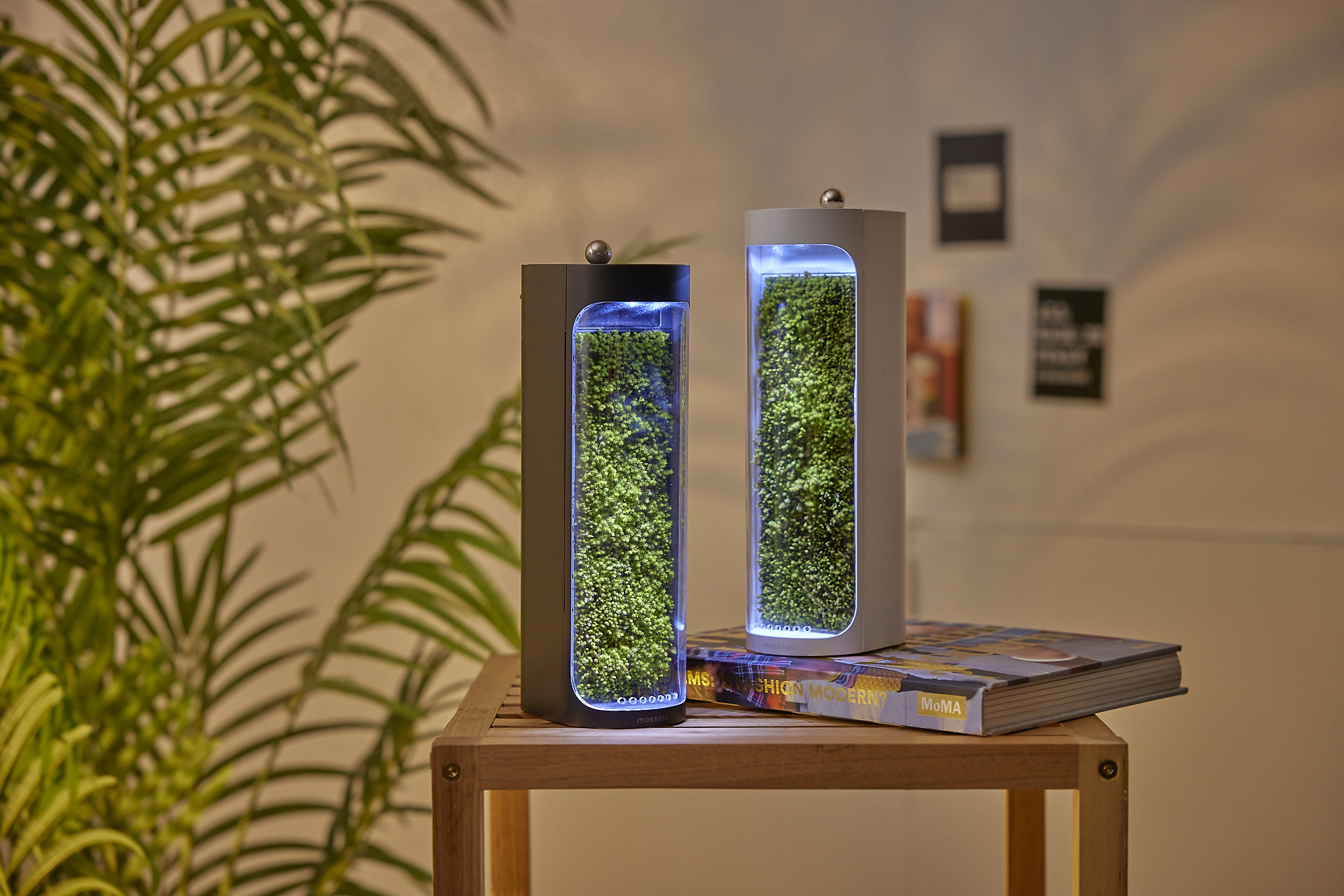
"Moss air purifier" has become a catch-all search term for a small but growing category of home products built around one idea: real, living moss doesn't need soil, survives on misting alone, and looks striking sitting in a room. The most recognizable product in this space is the Mosslab Moss Air — a compact, USB-C rechargeable desktop device (around 10 inches tall) that houses a removable moss panel behind a magnetic front window, paired with a small humidifier/mist unit and an ambient LED light.
A second, distinct format is the framed living moss wall panel — like Moss Acres' MossAire — which is designed to hang on a wall like art rather than sit on a desk, using a specific moss species (often called "mood moss") that's misted directly rather than paired with an internal humidifier mechanism.
How the moss and mist function works
Both formats rely on the same basic biology: moss is a rootless plant. Instead of drawing water and nutrients through roots, its entire leaf surface absorbs moisture directly, which is why misting (rather than watering soil) keeps it alive. In the desktop devices, a small water tank feeds an ultrasonic mist function; you can typically switch between "humidifier mode" (releasing purified mist into the room) and "terrarium mode" (misting the moss panel directly to keep it healthy), often controlled by moving a small magnetic ball between two positions.
The moss itself is genuinely low-maintenance — most product listings describe it as able to survive up to six months without any moisture at all, going dormant and then reviving once misted again, which is part of why these products are marketed as "fuss-free."
Does moss actually purify air? What the evidence says
This is the question worth being direct about, because it's also the most disputed part of the marketing. A few things are well-established in the scientific literature: moss's leaf structure gives it a genuinely large surface area, and outdoor moss is a well-documented "biomonitor" — researchers have long used moss to measure airborne pollutants like heavy metals and nitrogen/sulfur deposition, precisely because moss passively captures particles from the surrounding air over time.
Where the marketing gets ahead of the science is in translating that outdoor biomonitoring property into a meaningful indoor air-purification claim for a small, unsealed panel of moss sitting on a desk or wall. Independent hands-on reviewers who've tested desktop moss devices have generally been unconvinced that a palm-sized moss panel measurably cleans the air in anything but a very small, enclosed space, and have noted that manufacturer air-quality claims are typically supported by anecdotal customer testimonials or single at-home meter readings rather than independent, replicated lab testing.
It's also worth knowing that within the moss-product industry itself, there's disagreement about this exact point: some moss-wall brands market untreated living moss panels as air filters, while at least one competing moss-wall company has stated publicly that plain, unmodified moss on its own is not an effective air filter, arguing that only proprietary, lab-tested treatments meaningfully boost a moss panel's air-filtering capability. That's a useful signal — even within the category, "does moss on its own purify air" is a live debate, not settled fact.
The fair, balanced takeaway: living moss plausibly does something to the air immediately around it — it's a real, biologically active surface, and it does add humidity, which itself makes air feel and sometimes measure as fresher. But no widely available desktop or wall moss product on the market today has independent, third-party lab data showing it meaningfully purifies air in a typical room the way a certified HEPA air purifier does. Buy one for the humidification, the aesthetic, and the calming "bring the outdoors in" effect — treat any specific air-quality percentage or before/after claim on a marketing page with the same skepticism you'd apply to any wellness gadget.
Desktop device vs. moss wall frame: which format fits you?
Desktop moss humidifier/purifier (e.g. Mosslab Moss Air): smaller footprint, genuinely functions as a humidifier with a real water tank and mist output, rechargeable and portable, and doubles as a small terrarium display. Best if you want a functional device for a desk, nightstand, or small room.
Living moss wall frame (e.g. MossAire): larger, framed, hung like art rather than placed on a surface, no internal electronics or battery — just daily misting by hand. Best if you want a bigger visual statement piece and don't need the humidifier function, and are comfortable with once-daily manual misting rather than a device doing it for you.
Who this is (and isn't) a good fit for
Good fit if: you want a low-maintenance houseplant alternative, you like the aesthetic and scent of live moss, you want a genuinely functional small humidifier with a nature-forward design, or you're drawn to biophilic decor for a calming desk, bedroom, or office setup.
Not a good fit if: you're buying it specifically to replace a HEPA air purifier for allergies, asthma, or a diagnosed respiratory condition. None of these products have the kind of independent, certified air-quality testing that medical-grade air purifiers do, and they cover only a very small volume of air around the unit itself.
Care, maintenance & things to know
- Misting frequency matters both ways. Under-misting will let the moss go dormant (recoverable), but over-misting can harm it — several product guides specifically warn against misting too frequently, since moss can be damaged by excess moisture just as easily as by dryness.
- Replacement panels exist because moss is a living, changing material. Expect gradual color change over time as a normal part of owning a living plant, and budget for an occasional replacement moss filter if yours dries out permanently.
- Charging notes for desktop devices: some models specifically instruct against using a fast-charging adapter, requiring a standard lower-output USB adapter instead — worth checking your specific model's instructions before charging.
- It only affects a small area. Even optimistic accounts of moss air purification describe effects concentrated in a small, enclosed space rather than a whole room or home, so set your expectations by square footage, not by the room count in a marketing photo.
- This is a humidifier/decor purchase, evaluated as one — a genuinely pleasant way to add greenery and moisture to a space, not a certified medical-grade air treatment.
None of this is meant to talk you out of a moss air purifier — the humidification, low-maintenance care, and calming aesthetic are real and well-documented benefits. It's meant to set the air-purification expectation correctly before you buy.