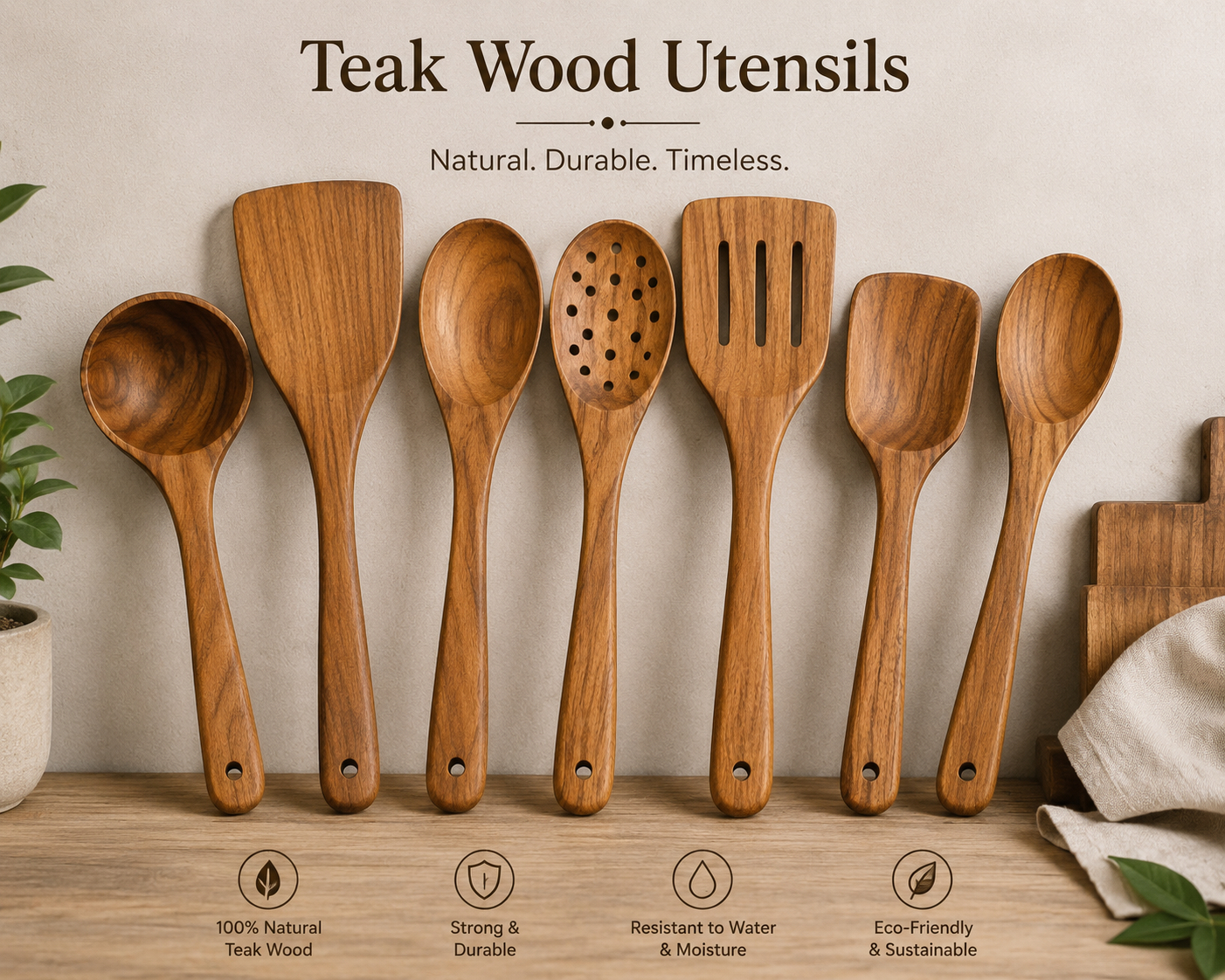
What teak wood utensils actually are
Teak wood utensils are kitchen tools — spoons, spatulas, turners, ladles, and salad servers — carved from Tectona grandis, a tropical hardwood native to South and Southeast Asia, particularly Myanmar, Thailand, Indonesia, and India. What sets teak apart from most other utensil woods is its naturally high content of oils and silica, which the tree develops as protection against moisture and insects in its native humid climate. That same natural chemistry is what makes teak so well suited to a wet, heat-heavy kitchen environment.
Unlike bamboo (which is technically a fast-growing grass rather than a hardwood), teak is a genuine dense hardwood, registering around 655 kg/m³ in density and roughly 1,070 pounds-force on the Janka hardness scale — hard enough to resist dents and scratching, but still gentle on cookware surfaces. Teak wood kitchen utensils are typically sold as sets (commonly five to ten pieces plus a holder) rather than individual items, positioned as a one-time, long-term purchase rather than a disposable kitchen tool.
Is teak wood good for kitchen utensils?
Yes — on the specific points that matter most for kitchen tools, teak performs well above average compared to most alternative woods:
- Water and moisture resistance. Teak's natural oil content creates a built-in barrier that reduces water absorption into the grain, which lowers the risk of swelling, warping, and mold compared to more porous woods like acacia or basic pine.
- Heat tolerance. Teak's low thermal conductivity means handles stay cooler to the touch during stovetop cooking, and the wood itself resists melting, warping, or leaching compounds under normal cooking heat — unlike plastic or silicone utensils exposed to prolonged high temperatures.
- Cookware-safe surface. Teak is dense but non-abrasive, so it won't scratch non-stick coatings, enamel, ceramic, or stainless steel the way metal utensils can.
- Odor and stain resistance. The tight grain structure resists absorbing strong food odors and pigments (turmeric, tomato sauce) better than more porous, open-grain woods.
- Longevity. With basic care, teak utensils commonly last a decade or more, whereas cheaper hardwood or bamboo utensils are more often replaced every few years.
The honest caveat: teak isn't magic, and "good for kitchen utensils" doesn't mean "maintenance-free." It still needs hand-washing, thorough drying, and occasional oiling like any quality wood utensil — it simply needs it less often than softer, more porous alternatives.
Are teak utensils healthy?
Properly finished teak utensils are widely regarded as a safe, non-toxic choice for food contact, and there's no credible evidence of teak itself posing a health hazard in normal kitchen use. A few specifics worth knowing:
Natural antibacterial properties: teak's oils and dense, tight grain leave little room for moisture or food particles to penetrate the wood, which limits the surface area available for bacterial growth compared to more porous woods. This is a genuine, well-documented characteristic of oil-rich hardwoods, not a marketing invention — though it's a reduction in bacterial harborage, not sterilization, so normal hand-washing after each use still matters.
No synthetic chemicals, when properly finished: quality teak utensils are typically finished with food-safe mineral oil, tung oil, or beeswax rather than synthetic sealants, meaning there's nothing to leach into food the way BPA or certain plastics can under heat. This is true of any well-made wooden utensil, not unique to teak, so it's the finish and manufacturing quality — not the species alone — that determines this.
One allergy note: teak dust and sap can occasionally cause skin irritation in woodworkers during manufacturing, and a small number of people report contact sensitivities to certain tropical hardwoods generally. This is uncommon and mainly relevant during production, not typical finished-utensil use, but if you have known wood or tree-nut-adjacent sensitivities, it's worth mentioning to the seller before buying.
In short: "healthy" here means "safe, non-toxic, and low in bacterial harborage" — not that teak provides any nutritional or medicinal benefit. It's a solid, low-risk material choice, on par with other reputable food-safe hardwoods.
What are the disadvantages of teak wood?
Teak has real strengths, but it's not the right choice for every kitchen or budget. The honest downsides:
- Higher cost. Teak utensils typically cost three to five times more than bamboo or basic softwood alternatives, and a full set can run well above budget hardwood options like beech.
- Heavier weight. Teak's density gives it a solid, stable feel in hand, but that same density makes it noticeably heavier than bamboo or maple — some cooks find this tiring during long stirring or mixing sessions.
- Still requires maintenance. Despite its natural oils, teak isn't maintenance-free — it benefits from periodic re-oiling to prevent the surface from drying out and developing surface cracks over time, and it should never go in a dishwasher or soak in water.
- Sourcing and sustainability concerns. Because teak is a slow-growing tropical hardwood, wild-harvested teak from unmanaged forests raises legitimate sustainability questions. Plantation-grown, FSC-certified teak addresses this, but not every product on the market is certified, so it's worth checking before buying.
- Color and grain inconsistency. As a natural material, individual teak pieces can vary in shade and grain pattern, even within the same set — a feature some buyers love and others find inconsistent-looking.
- Not ideal for very high, sustained heat. Like any wood utensil, teak can scorch or develop surface damage if left resting directly in a very hot pan or over an open flame for extended periods.
None of these are dealbreakers for most kitchens — they're simply trade-offs worth weighing against teak's durability and water resistance before you buy.
What is the best wood for eating utensils?
There isn't a single universal "best" wood — the right choice depends on whether you're prioritizing durability, cost, weight, or aesthetics. Here's how the most common options compare:
- Teak — the top pick for durability and moisture resistance; ideal for cooks who use utensils daily and want a tool that lasts over a decade. Higher cost and weight are the trade-offs.
- Maple — the most popular all-around choice; hard, closed-grain, flavor-neutral, and significantly more affordable than teak, though it needs more frequent oiling and isn't quite as water-resistant.
- Olive wood — dense, striking grain patterns, and naturally antibacterial, often sourced from pruned (not felled) olive trees; excellent for serving pieces but typically pricier and needs regular oiling to avoid small surface cracks.
- Walnut — strong and attractive with a dark tone that hides stains well, but slightly softer than teak or maple, and some woods in this family can carry mild flavor-transfer or allergy considerations for tannin-sensitive users.
- Acacia — a solid mid-range option, water-repellent and durable, though more porous than teak and less resistant to prolonged humidity.
- Bamboo — the most affordable and sustainable (it's a fast-growing grass, not a hardwood), lightweight and easy to handle, but shorter-lived and more prone to splitting under sustained high heat.
- Beech — a budget-friendly, uniform-grain hardwood that performs well for everyday tasks, though it needs more frequent oiling than teak to stay moisture-resistant.
For most home cooks, the practical answer is: if you cook daily and want a "buy it once" utensil, teak or maple are the strongest picks; if budget or weight matters more, bamboo or beech are reasonable, lower-cost alternatives.
How to care for teak wood utensils
- Hand wash only. Use warm water and mild dish soap; skip the dishwasher, whose heat and prolonged moisture exposure can cause warping over time.
- Dry immediately. Don't let teak utensils air-dry in a wet sink — towel-dry them right after washing and let them finish drying upright.
- Never soak. Prolonged submersion works against teak's natural water resistance and can loosen the wood's fibers over time.
- Oil periodically. Apply a food-safe mineral oil, tung oil, or dedicated teak oil every few months (or whenever the surface looks dry) to maintain the wood's natural moisture barrier.
- Store dry, out of direct sun. Prolonged sun exposure and heat can dry out the wood faster than normal use would.
- Inspect before each use. Check for cracks or splintering, and retire any piece that shows deep cracks rather than risk wood fragments in food.
What to check before you buy
- FSC certification or plantation sourcing. Look for Forest Stewardship Council certification or an explicit plantation-grown claim to avoid unmanaged wild-harvested teak.
- Real teak vs. "teak-style." Genuine teak is noticeably heavy and dense with a bold, visible grain; oddly lightweight or uniformly cheap multi-piece sets are a common sign of mislabeled acacia or other substitute woods.
- Finish type. Confirm the set uses a food-safe oil finish (mineral oil, tung oil, beeswax) rather than an unspecified lacquer or synthetic coating.
- Piece count vs. need. Full 8-10 piece sets are common, but a smaller starter set (spatula, spoon, turner) is a reasonable way to try teak before committing to a full kitchen set.
- Return and warranty terms. As with any kitchenware purchase, check the seller's return policy directly, since these vary by retailer.
1A02IP at checkout for a discount on select teak wood utensil sets.